















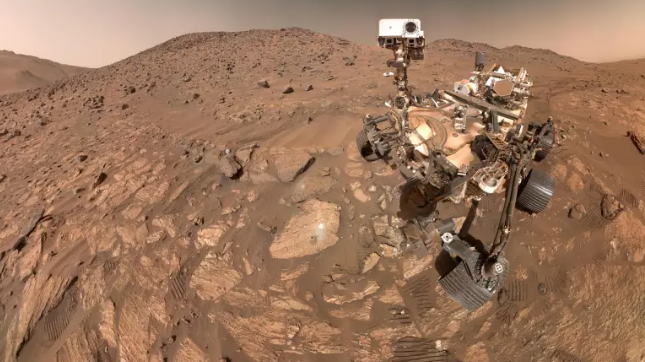
For years, movies have been made about aliens, saying that Earth is not alone in the universe and that there has to be something else out there. Yet, for years, we had not been close to discovering any other forms of life. Until recently, that is. Two years ago, in July of 2024, NASA’s Mars rover (Perseverance) discovered what could potentially be biosignatures on a rock on Mars. Having this information could change everything we know about the world beyond our own. These biosignatures could lead scientists to find other forms of life throughout the solar system.
A biosignature is a “characteristic, element, molecule, or substance that can be used as evidence for past or present life” (NASA Astrobiology). Examples of biosignatures are leaves, feathers, fossils embedded in rocks, or even a body of water. In addition, chemical biosignatures offer scientists different ways to analyze if there is additional life on a planet by studying “the chemistry of rocks, bodies of water, and even atmospheres” (NASA Astrobiology).
The Mars rover has been around for a long time, but the biosignatures it found are beyond impressive. The sample collected was found in a dry riverbend near the Jezero Crater, and the sample, “Sapphire Canyon,” was said to contain potential biosignatures. Scientists reveal that the finding by the Mars rover has the possibility to “preserve evidence of ancient microbial life” (NASA). NASA says that the sample that the Mars rover found is “the closest we have ever come to discovering life on Mars” and that the biosignature “is a groundbreaking discovery that will advance our understanding of Mars.”
The rock that the Mars rover found the sample on was said to have leopard-like spots, which are called concentric reaction fronts. These fronts are “where chemical and physical reactions occur” in different types of minerals, which is what allowed us to analyze and figure out what these biosignatures mean for lifeforms on Mars (The Current). For our planet, there is a mineral called vivianite, which is found in environments with “decaying organic matter” and is a part of a chemical reaction involving oxidation and reduction (The Current). In some instances, these reactions are very slow and need help from living organisms to continue. It has been explained that this process is “how many microbes, such as bacteria, get the energy to live,” causing scientists to think that bacterial life could have impacted the reaction and “created these mineral signatures” (The Current).
The idea that these bacteria could have influenced life on Mars is an important discovery for the scientific community. With more analysis, this discovery can help scientists figure out how possible it is for extraterrestrial life on nearby planets. However, the Mars rover is not the only invention to discover biosignatures.
Back in 2021, NASA created the James Webb Space Telescope (JWST), and the main purpose of this invention was to observe our universe through the usage of infrared light and to study how galaxies are able to form and change. NASA claims that the JWST “is the premier observatory of the next decade” and will be influential in space exploration in the next few years.
As of April 2025, NASA has put the James Webb Space Telescope to work. Since the Mars rover is confined to Mars, the JWST floats around outer space and analyzes different planets, detecting if they “have atmospheres and, critically, begin to study the chemical composition of those atmospheres,” which can help scientists by giving “clues about habitability and potential biosignatures,” one of them being gases produced by life forms (JWST). Even though the James Webb Space Telescope was not made to search for life on other planets, the fact that the telescope did makes it “the first observatory capable of characterizing the atmospheres” in surrounding orbiting planets (JWST).
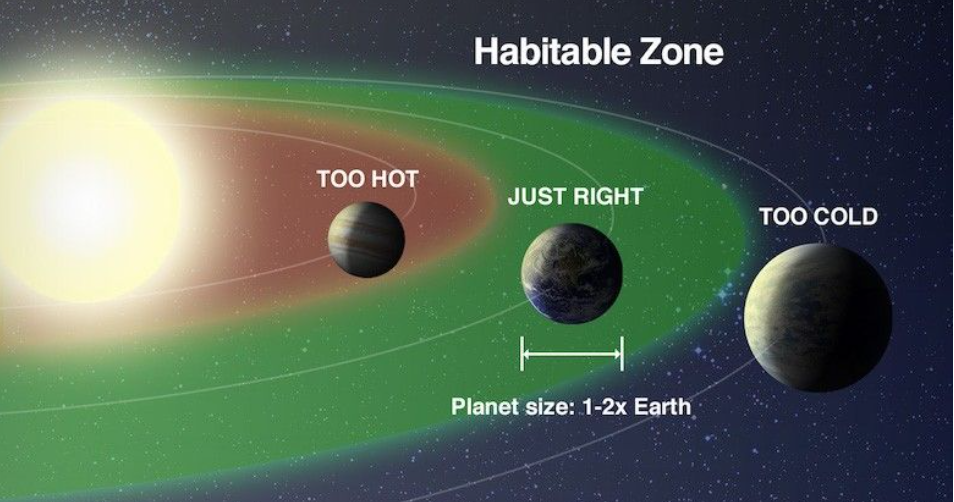
The James Webb Space Telescope reportedly found possible biosignatures on a planet other than Mars (which was the only one we knew about at that point). The planet is called K2-18, and it is around 120 light-years from Earth. K2-18 is an exoplanet where the JWST may have discovered a biosignature gas (that could be produced by lifeforms), but scientists would need a lot more research conducted in order to come to a reasonable solution. The evidence on K2-18 is not as promising as the biosignature on Mars, but since the telescope has the ability to study the composition of a planet’s atmosphere, it may also possess the ability to detect “water within an exoplanet’s atmosphere,” which can help figure out where life in the universe is (Universe Today).
At the end of the day, we are still yet to find out what the samples and data mean for life beyond Earth, but there is still an idea that life can exist. As technology evolves and science continues to flourish, there is a high possibility that we can learn about other lifeforms on other planets through chemical reactions and their atmospheres.