















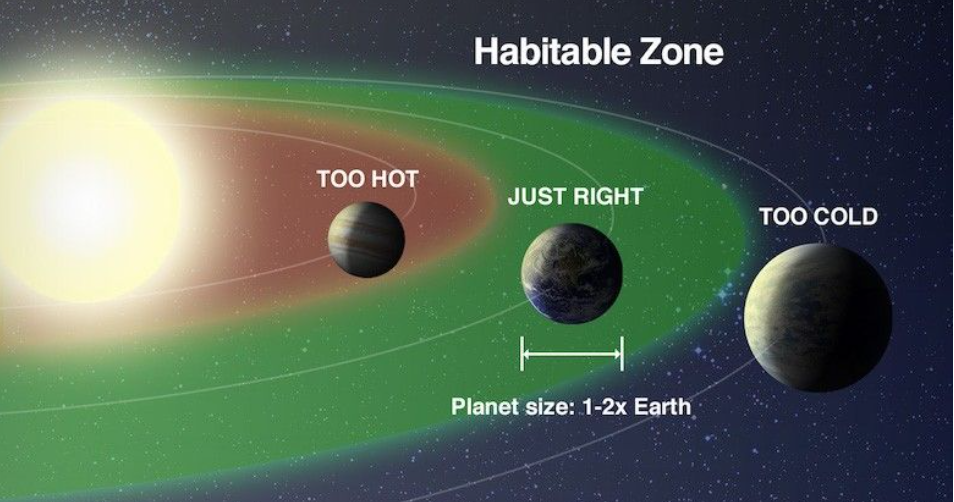
In the story, Goldilocks and the Three Bears, everyone remembers how Goldilocks went around and tested all of the items in the bears’ house. She complained how some were “too hot” or “too cold.” What if I told you there is an area in space that requires the same thing?
Since 1959, astronomers have come up with this concept called the “Goldilocks zone,” where exoplanets—planets that orbit a star outside of our main solar system—are not extremely close or extremely far from a star. This is what allows them to have the ability to house life on their planets. The Goldilocks zone is “where liquid water could exist on a planet’s surface,” which is what makes these planets so similar to Earth, which is the only planet in our solar system to have stable water on the surface (Science News). Today, this concept seems more like a reality.
For years, people and researchers have been doing everything to detect life on other planets. The idea of aliens has always been a matter of science fiction, given that there are so many movies about aliens living among us (like ET and Alien). But if there is a possibility for life to exist in the Goldilocks zone, who’s to say that there cannot be other life forms on these exoplanets?
On Earth, there is an abundance of phosphorus and nitrogen gas that is lacking in most exoplanets. Besides water, these two gases are crucial pieces of evidence that life is possible on another planet. These gases are important for planets because they “[assemble] cell walls, [encode] genetic information, and [build] proteins,” and scientist Craig Walter explains how, without these, “it is hard to come up with…alternative biology” (Science News). However, not every planet containing water, nitrogen, and phosphorus is a habitable planet. This has to do with the fact that the elements possess the ability to enter the core of a planet, which means that any nitrogen or phosphorus in the core of a forming planet will cause it to be uninhabitable.
When astronomers look for life in the Goldilocks zone, they do research to see which planets are similar to Earth and our conditions. Since the planets being researched are not part of the solar system we know, they orbit “stars [that are] slightly cooler and less luminous than our Sun,” which astronomers claim to be better for advancing life (The Habitable Zone). The stars that these planets orbit are called dwarf stars. Astronomers say that these stars are better for life on planets because they are able to burn constantly for around a trillion years, allowing time for “biological evolution to pursue an infinity of experiments for yielding robust life forms,” basically saying that it allows for a higher chance of life to evolve. The only downside to exoplanets orbiting dwarf stars is that these “stars are much harder to detect,” which makes it hard to find other life forms (The Habitable Zone).
The first example astronomers have seen is exoplanet K2-18b. The video, “The Planet JWST Discovered…” shares how this planet is located about “120 light-years from Earth,” which is actually considered pretty close in all of space and time (0:52). NASA has classified this exoplanet as a “super Earth” and it weighs around “8.92 Earths,” and unlike our home planet, which takes 365.25 days, K2-18b only “takes 32.9 days to complete one orbit” around its dwarf star (K2-18b). Similar to other exoplanets, it also orbits a dwarf star called K2-18, which is a red dwarf in the Leo constellation. Once again, these stars are great for these planets to orbit because they “live for trillions of years,” meaning the planets will have continuous stable energy. The only downside is that K2-18 does have a tendency to “flare and shoot out bursts of radiation,” which will make the ability to evolve difficult for lifeforms (1:46-1:55).
The term “super Earth” does not necessarily mean that the planet is an exact replica of our planet. K2-18b might not actually even be blue and green. NASA came up with a hypothetical visualization of the planet, and it is a combination of brown and tan, making it look more like Jupiter (which is a brown planet). A “super-Earth” is an exoplanet that is “larger than Earth and smaller than Neptune,” but they are usually rocky or rich with water (What Is a Super-Earth?). We do not know much about the state and nature of these planets currently, but NASA has been using the James Webb Space Telescope (JWST) on several different occasions to learn more about them. The most we know now is how much bigger they are than Earth and their temperatures.
Astronomers and scientists have been studying to find habitable planets for years. No one really knows why; we just assume it is for a later date and time, but there are so many exoplanets that have the opportunity to be habitable. At some point in our lifetime, we could end up learning of so many habitable planets that we might have more than the Star Wars universe. And if we do end up finding an Earth-like planet, are we the ones who are going to inhabit it, or will there already be life living there? Who is to say we are not able to live together? This may not be possible now, but I do not doubt that we will learn about life on these exoplanets at some point. Our technology is only evolving, and as long as we continue to research and learn new things, we can find anything we set our minds to.