















Global warming is influenced by factors such as cutting down forests, greenhouse gases, generating power, burning fossil fuels, and driving cars/trains. All of these things impact the way we live, whether it’s destroying the ozone layer or deteriorating our own home planet. What if there was another cause that our nation spends billions of dollars on? What if it was something we thought was not a big deal?
After World War II, space exploration became a largely talked-about topic. It mainly became important leading into the Cold War and the race against the Soviet Union to become the first people in space/on the moon. Since then, space travel has been used in novels, movies, and shows, gaining the interest of so many people. But what if I told you that space travel is not as beneficial as it seems? Although exploring space does give us more information about the planets and life beyond Earth, the smallest things about taking off into space impact our environment.
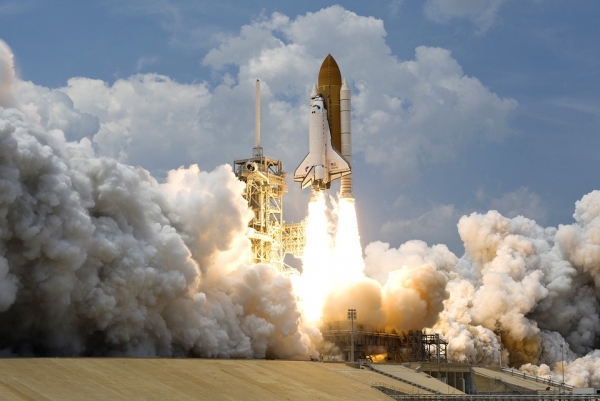
For instance, according to TIME Magazine, any time a spaceship gets launched, black soot is released back into the stratosphere, where it “lingers for up to five years, absorbing heat, contributing to climate change.” The black soot is formed by the engines burning kerosene, and when taking off, the engines can emit “a variety of gases and particles into the atmosphere,” which leads to “global consequences” (Medium). These “global consequences” are burning holes in the ozone layer, letting in a lot of harmful UV rays, and even emitting more greenhouse gases than there already are.
Even though exploring outer space is such a huge part of our world that we do not really know about, the use of satellites and rocketships is not worth ruining the ozone layer for. Christopher Maloney, an environmental scientist, explains how we must “learn more about the potential impact of hydrocarbon-burning engines on the climate at the surface of the Earth” because using hydrocarbon engines can warm up the planet. If this temperature change continues, it can “worsen summer monsoons in Africa and India” (TIME). Author Jeffrey Kluger also mentions how the soot from the kerosene in the engines can “linger for up to five years, absorbing heat, and contributing to climate change,” which adds to the idea that using non-ecofriendly rockets is destroying our environment. In addition to this information, NOAA shares that if we continue to use spaceships, the temperature in the stratosphere will increase “by 0.5 – 2° Celsius or 1 – 4° Fahrenheit.” This will result in global circulation changes.
Additionally, there are rocket motors called SRMs that emit chlorine gas instead of burning kerosene. Researchers claim that chlorine gas is also a serious threat to the ozone along with being the reason “spray cans” of the last century were banned (Medium). Scientists had also done plume sampling (which is a large column of gas or smoke that spreads throughout the environment) on an aircraft from NASA and showed “SRM plumes creating mini ozone holes that persist for several days after a launch” (Medium). If we don’t make the change to eco-friendly engines/spaceships, we will be dealing with the impacts of “UV radiation, which includes skin cancer and a weakened immune system in humans” for the next few decades (NOAA). This is why the switch to other materials is important.
There has been research that shows how “rockets are the only direct source of human-produced aerosol pollution above the troposphere,” which is about 5 to 10 miles above the surface of the Earth (NOAA). This means that even though we enforced the 1987 Montreal Protocol to minimize the influence of greenhouse gases, there are still many influences that we created that are ruining the ozone layer.
One way to fix this issue, although it’s in the testing stage, is by creating reusable rockets. Space companies that utilize reusable rockets can “cut down on resources consumed and emissions generated,” which means that all of the greenhouse gases and engines burning kerosene would be a lot lower (Science Direct). If every space company invested time in this idea, it could really improve the impact space launches have had on the ozone layer. Authors Slok Tan and Grace Nguyen also share how reusable rockets can “reduce…incidents by decreasing the amount of discarded rocket stages,” implying that reusable rockets would cost a lot less money than continuously building new ones that have to go through several test stages. In agreement with that, authors David Olawade, James Ijiwade, and Ojima Wada explain that reusable rockets “cut manufacturing needs and reduce…environmental costs” (Science Direct).
Another way to solve this problem is by using solar energy and green propellants. Solar energy, which is used in some spaceships, can minimize the amount of “fuel required and the environmental impact” of rockets, similarly to using reusable rockets (Science Direct). Additionally, the article also states how solar energy has been important in dealing with “space exploration, powering satellites, space stations, and deep-space missions” (Science Direct). If solar energy is this big of a deal for other space-related ideas, why are we not using it for rockets?
The last way to solve this issue is by using green propellants, which are “low toxicity, high energy liquid rocket propellants” that will offer high performance in rockets (NASA). Authors Slok Tan and Grace Nguyen add to this by explaining that green propellants are made “to reduce harmful emissions associated with rocket launches” while also reducing our carbon footprint, slowing temperature changes, and preventing the ozone from worsening (Welchman Keen). If we switch to using green propellants, it can make space launches simpler and cost less money in the long run. So, not only are we improving the conditions of the ozone layer, but we are also saving a lot of money.
Finally, I leave you with this: if we have the resources to improve space travel and exploration, why do we not? Is it because we do not care about the impact on our atmosphere, or do we just not want to spend money to change materials?