








The word “moxie” is defined as a force of character, determination, or nerve. There are so many important moments throughout history that only happened because of women who had moxie. In 1848, when Elizabeth Cady Stanton created the first women’s rights convention in Seneca Falls, Marie Curie became the first woman to win two Nobel Prizes in chemistry, and even when Sandra Day O’Connor became the first female U.S. Supreme Court Justice. All of these women, and more, had to face more prejudice and unfairness just to get to where they are today, but they got there because they had moxie. They did not want to give up their fight and kept pushing until they were just as equal as men.
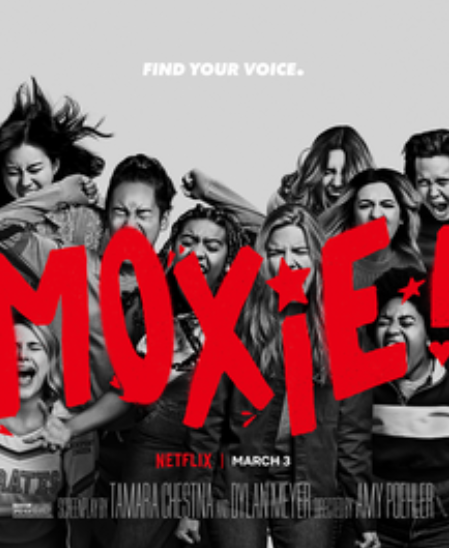
The Netflix movie, Moxie, was created by Amy Poehler (who starred in Parks and Rec) and is based on the book by Jennifer Mathieu. Moxie is about a teenage girl named Vivian who goes to a school where the popular boys give every girl a ranking in degrading categories. Vivian sees Lucy, a new student at her school, being harassed by a boy, Mitchell, in their class. She tells them to just “keep her head down, and he’ll [Mitchell] bother someone else” (17:19). Lucy does not take Vivian’s advice and explains to her that she should not have to keep her head down when she did not do anything wrong in the first place.
Another incident that happens in the movie is that another girl, named Kaitlynn, is told that she has to cover up during the school day because she was wearing a tank top. He makes the defense that it is over 90 degrees outside and that there is a guy in her class who was walking around the school without a shirt on. The principal tells her that it is not an excuse and that she is more worried about the girl causing an issue than the guy. The principal makes a comment saying that once she puts on a jacket, the class can “get back to learning,” when they had not even started class in the first place because she came and interrupted them (37:08).
After both of the incidents, Vivian brings it up to her mother (Amy Poehler) and finds out that her mom also spent her school days protesting with her friends. Her mom explains that they did not really know what they were doing, but it had to have helped women in some way. Vivan slowly realizes that there is a way for her to do something slightly similar to her mom’s protests. Vivian spends hours making magazines and filling them with information she wants other students to hear. At first, when she looks around the hallway to see if anyone has a magazine in their hands, Vivian cannot seem to figure out why no one is reading her work and starts to regret her idea. It’s only when the new girl, Lucy, is being picked on by Mitchell, who claims that he “knows she wrote it” (30:09). He throws it in the trash, and Vivian gives Lucy hers. It’s a small moment, but it creates such a big movement throughout the movie.
As the movie progresses, Claudia and Vivian’s dynamic shifts. While Vivian wants to do everything she can to change the environment at their school, Claudia is more nervous about the idea and the damage it can cause. She later reveals that she wanted to join in so many times, but she did not want to ruin all of the things her mother (an immigrant) gave her by giving up her entire life. It creates this image of how, even though changing things and sticking up for what you believe is a good thing and can offer change, there are also so many people who want to help but are too afraid of ruining things.
Later on, Vivian and her friend Claudia go to a house party and find out that a bunch of girls from school are starting a Moxie club. They interrogate one another to find out who actually wrote the magazine, but Vivian does not give in. During the next few weeks, Vivian prints more magazines, more people join the Moxie club, and nearly the entire school knows about the magazines. One of the biggest moments in the movie happens at a football game, where the principal announces who is running for the athletic scholarship. Mitchell, their star football player, is the only one running until Lucy nominates their friend Kiera (whose soccer team is undefeated while the football team is not as good). The two go head-to-head, and the girls campaign for Kiera’s win. They make posters and buttons, and Vivian puts them in the magazine. Everyone knows about Kiera’s campaign, and everyone wants to vote for her, which makes the Moxie club ecstatic that something could change around their school.
Only, the worst happens one morning when Vivian and Lucy assume that Mitchell is not at school because he is scared Kiera is going to beat him, only to find out that the principal allowed him to be on the morning announcements and create a negative image of the Moxie club. He tells the school that the magazine is harassing him and calling him names when he is the one doing it to the girls at school. When the time comes around for the scholarship to be awarded, the group becomes defeated when Mitchell wins over Kiera. They are mainly upset because they did so much work to help Kiera (and the girls at school) win at something when it changed nothing for any of them. The group gave so many reasons as to why Kiera would be a better candidate, yet it changed nothing for them, and Mitchell kept winning a scholarship he did not deserve.
As the week goes on, Vivian starts to disconnect from her friends and life. After Kiera’s loss, she feels like nothing she has to say will change the environment at her school. She starts to grow angry with the people around her and lashes out at her mom, boyfriend, and new friend group. She ends up in the principal’s office and argues with her about the fact that Mitchell was on the morning announcements, and Kiera was not. She is told that all they needed to do was ask, to which Vivian counters, “How were we supposed to ask if we were not told we could?” (1:23:21).
While she deals with the outcome of ignoring her friends and the anger towards her school, Vivian comes so close to giving up on Moxie and trying to change the school system. Only when she finds a letter addressed to Moxie in the girls’ bathroom does everything change. The letter does not have a name on it, but she talks about how she was assaulted by Mitchell. This letter makes Vivian think about all the things she has done and all the issues her friends have had to go through. As Moxie, Vivian issues a school-wide walkout in order to protest against Mitchell and any harassment going on at her school.
The next day, her teacher reads out a list of consequences that will happen to any student who walks out during the day, and they find out that the teacher who seemed unsure about the whole situation is supporting them. When the attendance bell rings, almost everyone walks out of their classes to support the girl who was assaulted. As they stand outside, Emma (the head cheerleader) reveals that she was the one who wrote the letter to Moxie because she felt like she was the only one who understood how to help her with the issue. So many other students come forward and explain their issues at the school, making Vivian realize how important her magazines are to all the students at her school.
This movie teaches the importance of finding our voices and not being afraid to speak out against unfair treatment. It also deals with issues that are minimized for women and makes them into a big deal while also teaching about the sexism that happens around the world (like Kiera not getting the athletic scholarship for being the best player). Some of the situations are made to be more extreme because they showcase the severity of the issue. Even if it may not be a big deal at all schools, Moxie wants to make the point that these issues are happening; we should stop them.
Even though Moxie does not touch on the same struggles that Marie Curie, Elizabeth Cady Stanton, or Sandra Day O’Connor went through, it still shows how women (especially teens) are facing struggles with being harassed and viewed as less than men, all while trying to do what they can to overcome these issues. They use all of the moxie they have and fight back for what they believe is right. This led women to where we are today.